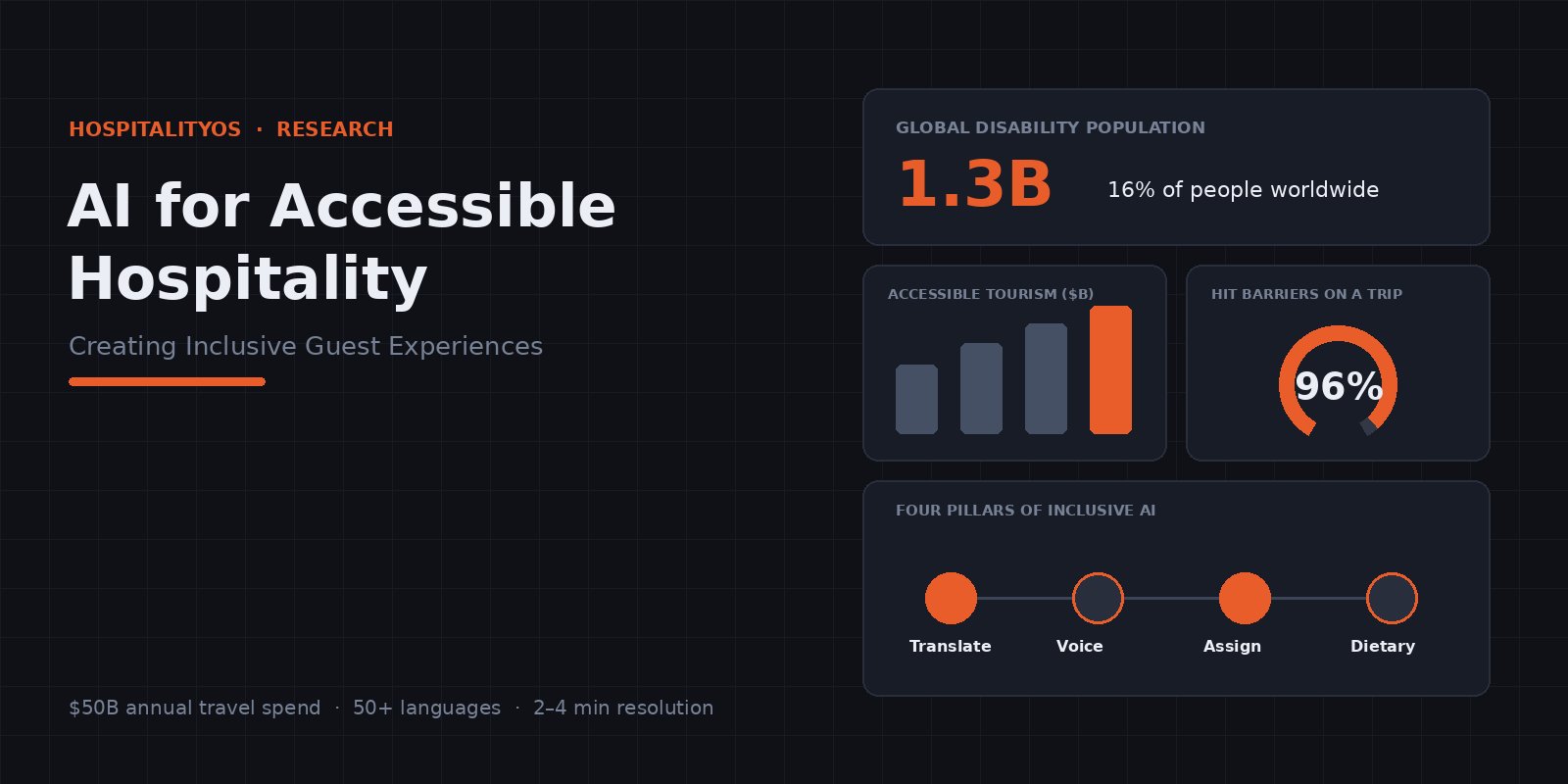
Accessibility is the largest guest segment your hotel is almost certainly underserving. Not a niche, not a compliance obligation to be managed at minimum cost - a market of 1.3 billion people worldwide who travel, spend, and remember exactly how they were treated. The World Health Organization now estimates that 16% of the global population, roughly one in six people, lives with a significant disability. In the United States alone, travelers with disabilities spend on the order of $50 billion a year on travel, and they rarely travel alone: they bring partners, families, and companions whose spending rides on whether a property can accommodate everyone in the party.
And yet the experience these guests receive remains, by their own account, dismal. Survey after survey finds that the overwhelming majority of travelers with disabilities encounter accessibility problems on their trips - one widely cited figure puts it at 96%. More than half report being given a different room than the accessible one they carefully booked. The result is a market that is simultaneously enormous, loyal, and starved of properties that get it right. That is the definition of an under-competed opportunity, and it is exactly the kind of gap that artificial intelligence is now positioned to close.
The critical distinction to hold onto from the outset: compliance and inclusion are not the same thing. A hotel can have every ADA-required grab bar, roll-in shower, and visual alarm and still deliver an experience that fails deaf, blind, mobility-impaired, neurodivergent, and non-English-speaking guests at every touchpoint that a building code never contemplated - the booking flow, the front-desk conversation, the room controls, the restaurant menu. AI does not replace the physical baseline. It attacks the service and communication layer that compliance never reached.
The inclusion gap hotels keep overlooking
Start with the size of the prize, because it reframes everything that follows. The accessible-tourism market in North America was valued at roughly $341 billion in 2025, about a third of the global total. These are not marginal guests booking the cheapest available rate; travelers with accessibility needs tend to plan further ahead, stay longer, return to properties that serve them well, and travel in groups - over 75% stayed in a hotel across a two-year span. They are also, structurally, a segment that pays a hidden surcharge: more than 80% of travelers with accessibility needs report spending an extra 10% to 30% of their total travel budget on accessibility-related costs that other guests never incur. A hotel that removes even part of that friction is not just being decent - it is capturing wallet share that competitors are actively pushing away.
The friction is real and specific. A deaf guest cannot use a phone-based front desk after hours. A blind guest cannot read a printed room-service menu or operate a capacitive touch panel with no tactile feedback. A wheelchair user books an accessible room online and arrives to find it was released to a walk-in because the property management system treated it as ordinary inventory. A guest with a severe nut allergy is handed a menu that lists no allergens and served by staff who cannot reliably answer. A traveler who speaks only Mandarin or Arabic cannot explain any of these needs at all. None of these failures are addressed by a building inspection. Every one of them is now addressable by AI.
It helps to map the categories of need against the AI capabilities that serve them, because "accessibility" is not one problem but a family of them, each with a different technical answer.
| Guest need | Where hotels fail today | AI capability that helps | Primary touchpoint |
|---|---|---|---|
| Deaf / hard of hearing | Phone-only service; no captions | Text-first messaging, live captioning, visual alerts | Booking, front desk, in-room |
| Blind / low vision | Printed menus; touch-only panels | Voice control, screen-reader-ready UI, audio wayfinding | In-room, dining, website |
| Mobility impaired | Wrong room assigned; long routes | Mobility-aware assignment, accessible-route guidance | Reservations, arrival |
| Neurodivergent / sensory | Overwhelming, unpredictable environments | Sensory-profile personalization, low-stimulation modes | In-room, common areas |
| Non-native language | No shared language with staff | Real-time translation across 50+ languages | Every touchpoint |
| Dietary / medical | Unknown allergens; risky meals | Allergen cross-referencing, safe-menu generation | Dining, room service |
Read that table as a product roadmap rather than a list of complaints. Each row is a discrete capability a hotel can add - and each maps to technology that already exists, is affordable at property scale, and layers onto systems most hotels already run. The rest of this article works through the four highest-leverage capabilities in turn: real-time translation, voice-controlled rooms, mobility-aware assignment, and dietary intelligence - before turning to the digital front door, implementation, and the business case.
Real-time translation: removing the language barrier
Language is the accessibility barrier that touches the most guests and gets discussed the least. A guest who cannot communicate with your staff cannot request an accessible feature, describe a medical need, report a problem, or feel welcome - and until recently the only fixes were hiring multilingual staff for every shift or fumbling through a phrasebook. AI has changed the economics entirely. Modern guest-messaging platforms now translate inline across more than 50 languages, inside the same chat window, menu, or welcome email the guest already uses. There is no separate app, no relay through a third party, no waiting for the one front-desk agent who speaks the language to come on shift.
The performance data is striking. On multilingual conversations, time-to-resolution drops from 12 to 25 minutes with manual or human-relay translation to 2 to 4 minutes with AI handling the translation inline. That is not a marginal efficiency gain - it is the difference between a guest getting help and a guest giving up. And the revenue effect is measurable in adjacent areas: hotels deploying multilingual menus report a 15% to 25% lift in food-and-beverage spend per stay, simply because guests order more when they can read and trust what they are ordering. Inclusion and revenue point in the same direction.
| Service dimension | Manual / human-relay | Inline AI translation |
|---|---|---|
| Language coverage | Limited to staff on shift | 50+ languages, always available |
| Resolution time | 12–25 minutes | 2–4 minutes |
| Availability | Daytime / staffed hours | 24/7 across every channel |
| Where it lives | Separate app or interpreter | Inside chat, menu, and email |
| F&B effect | Under-ordering, confusion | 15–25% lift per stay |
A guest who cannot communicate cannot ask for the accommodation they need. Real-time translation is not a convenience feature - it is the precondition for every other kind of accessibility to function.
The adoption curve confirms this is becoming table stakes rather than a differentiator you can defer. Roughly 90% of hotels have either adopted or plan to adopt AI-assisted guest messaging, and 82% expect to expand their AI usage in 2026. Industry surveys likewise find 71% of hospitality professionals call AI's impact significant or transformative. The properties acting now are setting a service standard; the ones waiting will be explaining to guests why the hotel down the street can help someone in their own language and they cannot. The governance point matters too: AI should carry the routine load - requests, directions, dining, housekeeping - while sensitive or high-stakes conversations escalate to a human with one tap. Speed and coverage from the machine; judgment and empathy from staff.
Where does your property actually stand? The AI Readiness Score takes two minutes, asks no one for a call, and emails you a report sized to your rooms and ADR.
Get Your ScoreVoice-controlled rooms: independence by default
For a guest with limited mobility or vision, the hotel room is a landscape of small obstacles: a thermostat across the room, a light switch by the door, a phone on the nightstand, a television remote with unlabeled buttons. Voice control collapses all of it into a single accessible interface. A guest can adjust the temperature, dim the lights, open the drapes, call the front desk, and order room service without crossing the room or locating a control - and the same capability that delivers independence to a disabled guest reads as premium convenience to everyone else, which is why it is spreading so fast.
The market has tipped decisively. An Oracle study found that 78% of hotel operators expected voice-activated controls for lights, climate, and room devices to be a mainstream feature by the end of 2025. Guest demand backs it: PwC's 2025 hospitality technology research found 62% of guests prefer tech-enabled room controls, rising to 84% among Gen Z travelers, and voice-controlled rooms have been shown to lift guest satisfaction measurably. When a feature is simultaneously an accessibility necessity for some guests and a premium preference for the majority, the investment case stops being about compliance and starts being about competitiveness.
The design principle that separates genuinely inclusive voice control from a gimmick is flexible input and output. A blind guest needs audio confirmation of every action. A deaf guest needs the same controls available as text or on-screen. A guest with a speech difference needs the system to understand non-standard speech patterns or offer an alternative input. AI is what makes this range possible - natural-language understanding that tolerates accents, phrasing, and imperfect commands, rather than a rigid command set that only works if you say the exact right words in the exact right way.
| Interaction | Manual / conventional approach | AI-enabled approach | Guest impact |
|---|---|---|---|
| Room controls | Physical switches, panels, remotes | Voice + multimodal control | Independence without physical effort |
| Requests after hours | Phone call to front desk | Text/voice assistant, 24/7 | Deaf & non-verbal guests served |
| Communication | Whoever is on shift speaks the language | Inline translation, 50+ languages | Resolution in minutes, any language |
| Wayfinding | Printed signs, staff directions | Audio + accessible-route guidance | Blind & mobility guests navigate solo |
| Menus | Static printed card | Screen-reader-ready, allergen-aware | Safe, confident ordering |
The left column is what most hotels still offer. The right column is what a modern accessible hotel can offer at software cost. Note that none of the AI-enabled approaches require rebuilding the room - they run on tablets, in-room devices, and messaging channels that integrate with existing property systems. The barrier is no longer capital or construction; it is the decision to prioritize it.
Mobility-aware room assignment: keeping the promise
Here is the single most infuriating accessibility failure in all of hospitality, and it has nothing to do with the physical building: the guest who books an accessible room and does not get it. More than half of travelers with disabilities report being assigned a different room than the accessible one they reserved. The room existed. It was booked. And it was handed to a walk-in or an upgrade because the property management system treated it as fungible inventory rather than a medical necessity.
This is a data and workflow problem, which means it is precisely the kind of problem AI solves well. An intelligent assignment layer treats accessible rooms as protected inventory - never released, never over-assigned, flagged at every point where a human might otherwise override it. It matches the specific accessibility attributes of a room (roll-in shower versus tub bench, visual-alarm equipped, lowered fixtures) to the specific need on the reservation, rather than lumping every "accessible" room into one bucket. And it can extend beyond assignment into the arrival experience: routing a mobility-impaired guest along the shortest accessible path, pre-positioning equipment, alerting staff before the guest reaches the desk so nothing has to be explained twice.
The most damaging accessibility failure is not a missing ramp. It is booking the accessible room, arriving exhausted, and being told it is gone - a broken promise the guest will remember, and review, for years.
The reputational math here is unforgiving. A guest who is denied the room they need does not simply move on; they document it, they warn their community, and disability-travel networks are tightly connected and highly vocal. Getting assignment right is the cheapest reputation insurance a hotel can buy, and it requires no renovation - only that the systems already in place stop treating an accessible room as an ordinary one.
Dietary intelligence: safety at the table
Food is where accessibility becomes a matter of physical safety. A guest with a severe allergy or a medical dietary restriction is making a genuine risk assessment every time they order, and the traditional hotel answer - a printed menu with no allergen information and a server who "thinks" the sauce is nut-free - is a liability as much as a service gap. AI closes this in a way manual processes cannot scale to. An allergen-aware system cross-references every menu item against a guest's declared restrictions and instantly flags what is safe, what is not, and what can be modified, drawing on an ingredient and allergen database rather than a server's memory.
The reliability has reached the point of practical trust. AI menu-assistance systems trained on ingredient and allergen databases now interpret dietary restrictions with reported accuracy above 95%, cross-referencing multiple constraints at once - gluten-free and vegan and nut-free - to surface only genuinely safe options. The operational benefits stack on top of the safety case: properties using AI for special-diet handling report up to 30% faster table turnover on those orders and a 50% reduction in the staff training time previously required to keep allergen knowledge current across a rotating team. Safer for the guest, faster and cheaper for the operator.
The inclusion principle is the same one that runs through everything above: give the guest confident, self-directed control. A diner who can see exactly which dishes are safe, in their own language, without having to interrogate a server or disclose a medical condition to a stranger, orders more, worries less, and returns. Dietary AI turns the highest-anxiety moment of a stay into one of the most reassuring.
The digital front door - and the overlay trap
Every physical accessibility investment is undermined if a guest cannot get through the website to book in the first place. The hotel website is where the guest researches accessible features, understands what the property offers, and reserves the room - and it is also, increasingly, where hotels get sued. In 2025, 5,114 ADA digital-accessibility lawsuits were filed in the United States, part of 8,667 ADA lawsuits overall, with hospitality a perennial prime target. Digital accessibility litigation rose 37% in the first half of 2025 alone. This is no longer a theoretical compliance risk; it is a live and growing legal exposure.
The temptation, sold aggressively to hoteliers, is the accessibility "overlay" - a single line of JavaScript that promises instant WCAG compliance. It does not deliver it, and it can make things worse. In 2025, roughly 32% of all accessibility lawsuits involved websites that had an overlay installed, and in April 2025 the Federal Trade Commission finalized an order against an automated-accessibility provider that included a $1 million payment and explicit restrictions on marketing claims that an automated product can make a website compliant. The overlay is a false shortcut. Genuine accessibility comes from accessible markup, keyboard navigation, sufficient color contrast - low-contrast text remained the single most common failure, affecting 79% of home pages in 2025 - and real assistive-technology support.
| Dimension | Bolt-on overlay / widget | Genuine accessibility (AI-assisted) |
|---|---|---|
| What it changes | Cosmetic layer over broken markup | Underlying structure, contrast, navigation |
| Assistive-tech support | Often conflicts with screen readers | Native compatibility |
| Legal exposure | Present in ~32% of 2025 suits | Reduces litigation risk |
| Regulatory standing | FTC action & $1M order in 2025 | Aligns with WCAG conformance |
| Guest experience | Frustrating, unreliable | Usable, dependable |
| Role of AI | Marketed as a magic fix | Audits, flags, and monitors real issues |
Where AI genuinely helps on the web is not as an overlay but as an auditor and monitor: continuously scanning the site for contrast failures, missing alt text, broken keyboard paths, and unlabeled controls, then routing them to a developer to fix at the source. That is AI in a supporting role - surfacing and prioritizing real problems - rather than papering over them. The distinction is the whole game, and it is one hotels get wrong at a cost of a million dollars and a headline.
A framework for building inclusive AI
Pulling the threads together, an inclusive-AI program rests on four pillars, and the value comes from building them as a system rather than as disconnected features. Translation removes the language barrier. Voice and multimodal control remove the physical barrier in the room. Mobility-aware assignment removes the broken-promise barrier at arrival. Dietary intelligence removes the safety barrier at the table. Underpinning all four is an accessible digital front door that lets guests reach any of it in the first place. A hotel that installs voice control but still assigns the wrong room, or offers translation but serves an unsafe meal, has plugged one leak in a boat with five holes.
The sequencing matters because these capabilities depend on shared foundations - a unified guest profile that travels across booking, room, and restaurant; clean data on which rooms have which features; and integration with the systems already running the property. The build should mature data, model, and process together rather than bolting on point solutions that cannot talk to each other.
| Phase | Timeline | Focus | Success signal |
|---|---|---|---|
| 1. Audit & baseline | Weeks 1–4 | Web accessibility audit; map guest journey barriers | Documented gap list, WCAG scorecard |
| 2. Communication layer | Weeks 4–8 | Deploy inline translation & text-first messaging | Any-language resolution in minutes |
| 3. Room & assignment | Weeks 8–14 | Voice/multimodal control; protect accessible inventory | Zero mis-assigned accessible rooms |
| 4. Dining & personalization | Weeks 12–18 | Allergen intelligence; sensory profiles | Safe-menu generation live |
| 5. Operate & improve | Ongoing | Monitor, gather guest feedback, retrain | Accessibility complaints trending to zero |
Two decisions dominate the build. The first is staff role, not replacement: AI should absorb the repetitive, scalable work - translation, flagging, control, assignment logic - so that human staff are freed to deliver the empathy and judgment that a machine cannot. The worst version of inclusive AI is one that removes the human entirely and leaves a vulnerable guest talking to a bot with no escalation path. The best version puts staff escalation one tap away at every step. The second decision is genuine versus cosmetic: every capability here can be faked with a shortcut that looks like progress and delivers none - the overlay on the website, the rigid voice system that only understands perfect commands, the "allergen-friendly" menu with no real data behind it. Building for real is the difference between reducing risk and manufacturing it.
Hotels standing up this kind of capability for the first time usually benefit from designing it as one connected guest-experience system rather than a pile of point tools - mapping every barrier in the journey, then closing them in the right order. If you want a partner to architect inclusive, AI-enabled guest experiences end to end, explore our AI-Powered Guest Experience Systems service →.
Common pitfalls that undercut inclusive AI
Even well-intentioned hotels stumble in predictable ways, and naming the failure modes in advance is most of the defense. The first is treating AI as a substitute for physical compliance. No amount of software removes the legal and moral baseline of accessible rooms, routes, and alarms. AI raises the ceiling; the building still has to meet the floor. Marketing a "smart accessible room" that lacks a roll-in shower is worse than saying nothing.
The second is the overlay mentality applied everywhere, not just the website - reaching for the one-click fix that promises compliance and delivers a lawsuit. Whether it is a web widget, a translation tool that mangles medical terms, or an allergen system with no real ingredient data, the shortcut that looks like inclusion but is not is the most expensive mistake in the category, because it creates the appearance of safety where none exists and invites the guest to rely on it.
The third is removing the human. Accessibility is where guests are most vulnerable and most in need of a person who can exercise judgment. An inclusive-AI system that funnels a guest with a medical need into a dead-end chatbot has automated away exactly the moment where a human mattered most. Every capability in this article should have a visible, immediate path to a trained staff member. The goal is augmentation - staff freed from the routine to focus on the human - not substitution.
The business case and competitive stakes
Set aside, for a moment, the fact that inclusive design is the right thing to do, and the numbers still make the case on their own. This is a $50-billion-a-year market in the US, a $341-billion accessible-tourism market in North America, and 1.3 billion people worldwide - and it is chronically underserved by 96% of the trips these guests take. The competitive density is almost nonexistent: most hotels treat accessibility as a compliance minimum and compete on nothing beyond it. A property that decides to actually serve this segment is not fighting for share in a crowded field; it is claiming ground almost no one else is contesting.
Layer on the risk reduction. ADA digital-accessibility litigation hit a record 5,114 filings in 2025 and rose 37% in the first half of the year, with hospitality squarely in the crosshairs. Genuine accessibility - as opposed to the overlay theater that is itself now a litigation magnet and an FTC target - cuts that exposure materially. The AI capabilities that serve disabled guests are the same ones reducing the legal risk of ignoring them. The investment does double duty.
Finally, consider the halo. The technologies that make a hotel accessible - voice control, translation, allergen intelligence, smart assignment - are the same technologies that read as premium to every guest. The global AI-in-hospitality market is projected to reach $9.5 billion by 2030 at a 20% compound annual growth rate; inclusive design is not a detour off that curve but a particularly high-return path along it. The hotels that understand accessibility as a service advantage rather than a compliance cost will capture a loyal, high-value, under-served market and look more advanced to everyone else while they do it. That is a rare combination - margin, loyalty, reduced risk, and reputation, all pointing the same way - and the properties that move first will own it.
Frequently asked questions
Does AI replace the ADA-required accessible rooms and features a hotel already has to provide?
No. AI is additive, not a substitute for physical and structural compliance. Roll-in showers, grab bars, visual alarms, accessible routes, and the correct inventory of ADA rooms are legal baselines that no software removes. What AI does is close the service and communication gaps that compliance alone never addressed - making sure a guest who booked an accessible room actually receives it, can control that room without physical effort, can communicate in their own language, and can eat safely. Think of AI as raising the ceiling on inclusion after the building has met the floor.
How accurate is AI translation for real guest interactions?
Modern AI messaging platforms translate across 50+ languages inline, inside the same chat, menu, or email the guest already uses. Time-to-resolution on multilingual conversations drops from 12 to 25 minutes with manual or human-relay translation to 2 to 4 minutes with AI. Accuracy is high for routine hospitality interactions - requests, directions, dining, housekeeping - though sensitive or legal conversations should still route to a human. The practical standard is to use AI for speed and coverage, with staff escalation always one tap away.
Are accessibility overlays and widgets a safe way to make our website compliant?
They are not a substitute for genuine accessibility, and they carry real legal risk. In 2025 roughly 32% of all accessibility lawsuits involved websites that had an overlay installed, and in April 2025 the FTC finalized an order against an automated-accessibility provider that included a $1 million payment and restrictions on claims that a single line of code can make a site WCAG-compliant. Real conformance comes from accessible markup, keyboard navigation, sufficient contrast, and genuine assistive-technology support - not a bolt-on widget.
Do independent and boutique hotels benefit, or is inclusive AI only for large brands?
Independents often see the clearest return. A boutique property cannot staff a 24/7 multilingual desk or a dietitian on call, but AI translation, voice control, and allergen intelligence deliver those capabilities at software cost. Because a single mishandled accessibility request can sink a boutique's reputation on review sites, the reputational upside of getting it right is proportionally larger for smaller properties than for a flag with a national service infrastructure.
What is the business case beyond doing the right thing?
Travelers with disabilities spend roughly $50 billion a year in the United States alone, and 1.3 billion people worldwide - about 16% of the population - live with a significant disability. They travel with companions, are loyal to properties that treat them well, and are chronically underserved: 96% report accessibility problems on trips. Capturing even a sliver of a market that most competitors ignore, while reducing ADA litigation exposure that hit record volume in 2025, is one of the highest-ROI, lowest-competition moves available to a hotel today.